
Supporting Members with Autism: A Minority Quietly Driving the Majority of Costs
An Artemis client saw mental health spend climbing even though diagnosis rates hadn’t changed. In this case study, you’ll see how Artemis uncovered autism-related care as the silent driver behind the trend and how that insight opened the door to better support for families and smarter cost management.
Read on to:
- Learn how a small group of members with autism accounted for an outsized share of mental health spend
- See how out-of-network ABA therapy and provider concentration shaped both cost and access
- Explore the opportunities identified to improve affordability, access, and support for families navigating autism care
.png)
Overview
Our client, a global life sciences and diagnostics leader, relies on Artemis by Nomi Health to keep a close eye on emerging trends across their 65,000-member population. During a routine mid-year review, our analytics team noticed something that didn’t quite add up. Mental health costs were climbing, but the number of members with a diagnosis wasn’t.
Discovery
At first glance, nothing seemed unusual. Mental health costs were rising—a trend we’ve all come to expect in recent years. But when our team compared the numbers to diagnostic rates, something didn’t line up. The number of members with a mental health condition hadn’t really changed.
This piqued our interest. What was driving the increase?
We started pulling threads. Diving into the data, one category began to stand out: Autism Spectrum Disorder. It wasn’t the most common diagnosis, but it was quietly becoming one of the most expensive.
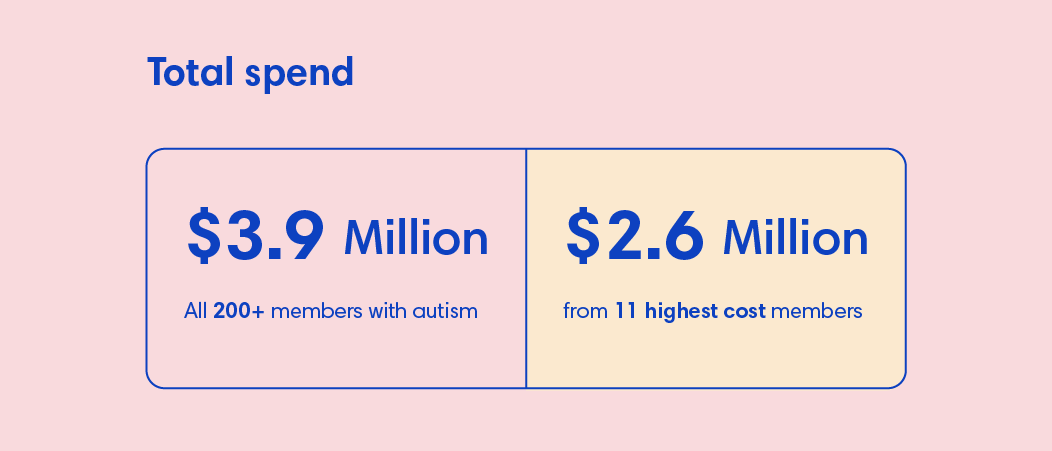
Out of roughly 65,000 covered members, only about 200 had an autism diagnosis. Yet together, they were responsible for nearly $4 million in annual spend. That's a 73% increase from the year before, and their PMPM costs were double that of the next-highest condition.
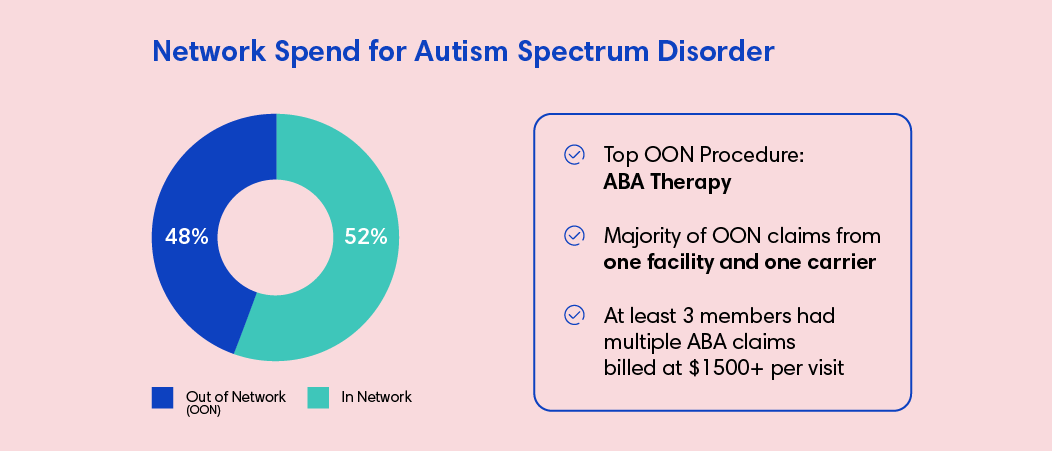
When we looked closer, we noticed a small handful of families—just 11 members—accounted for nearly $50,000 each in costs, most of it tied to Applied Behavior Analysis (ABA) therapy. And half of that care was happening out of network, with multiple sessions per day, funneled through a single facility and one carrier.
This spike in utilization was a signal. Somewhere between the data and the lived experience of these families, something had gone off balance.
“At first glance, the data was painting a picture of overuse. But we dug deeper to understand the truth and realized this was about access. The data was pointing to families who needed help but were forced out of network to get it.”
— Artemis Analytic Advisor
The Domino Effect
Even though only a small portion of members were affected, the impact on total spend was significant. Out-of-network ABA therapy was inflating costs and creating unnecessary hurdles for families trying to access consistent care.
The ripple effects:
- Families faced logistical and financial challenges navigating out-of-network therapy, not to mention the burnout that many parents experience when faced with the day-to-day challenges of caring for a child with autism.
- The employer had limited visibility into treatment quality and outcomes.
- The plan was paying more without necessarily improving member support or results.
The Action Plan
With a clearer picture in hand, the client and Artemis outlined a practical plan:
- Bring the provider in-network. Open conversations with the high-volume ABA facility to reduce costs and make care easier to access.
- Audit out-of-network exposure. Review claims patterns and carrier relationships to uncover other potential cost drivers.
- Enhance family support. Share information and resources to help employees navigate autism-related care more confidently.
These steps gave the client a roadmap to address the issue head-on and move from awareness to action.
The Outcome
While this work is still underway, the client is already seeing early progress:
- Negotiations to add the ABA provider in-network are in motion.
- Out-of-network utilization is trending downward.
- Families are reporting better access and less administrative friction.
“This analysis helped us get ahead of a cost trend we might not have caught on our own. It’s a reminder of how powerful good data can be.”
— Director of Global Benefits, Life Sciences Client
The Takeaway
While it is difficult to quantify the emotional and mental toll of caring for children with autism, the fact that members were seeking ABA therapy multiple times a day meant that they needed support. When members are unsupported in their lives outside of work, it often means having a harder time being present, productive, and happy at work. The data helped our client develop new ways to impact employee wellbeing, ensuring families with children on the spectrum have the access to resources and the stability they need.